
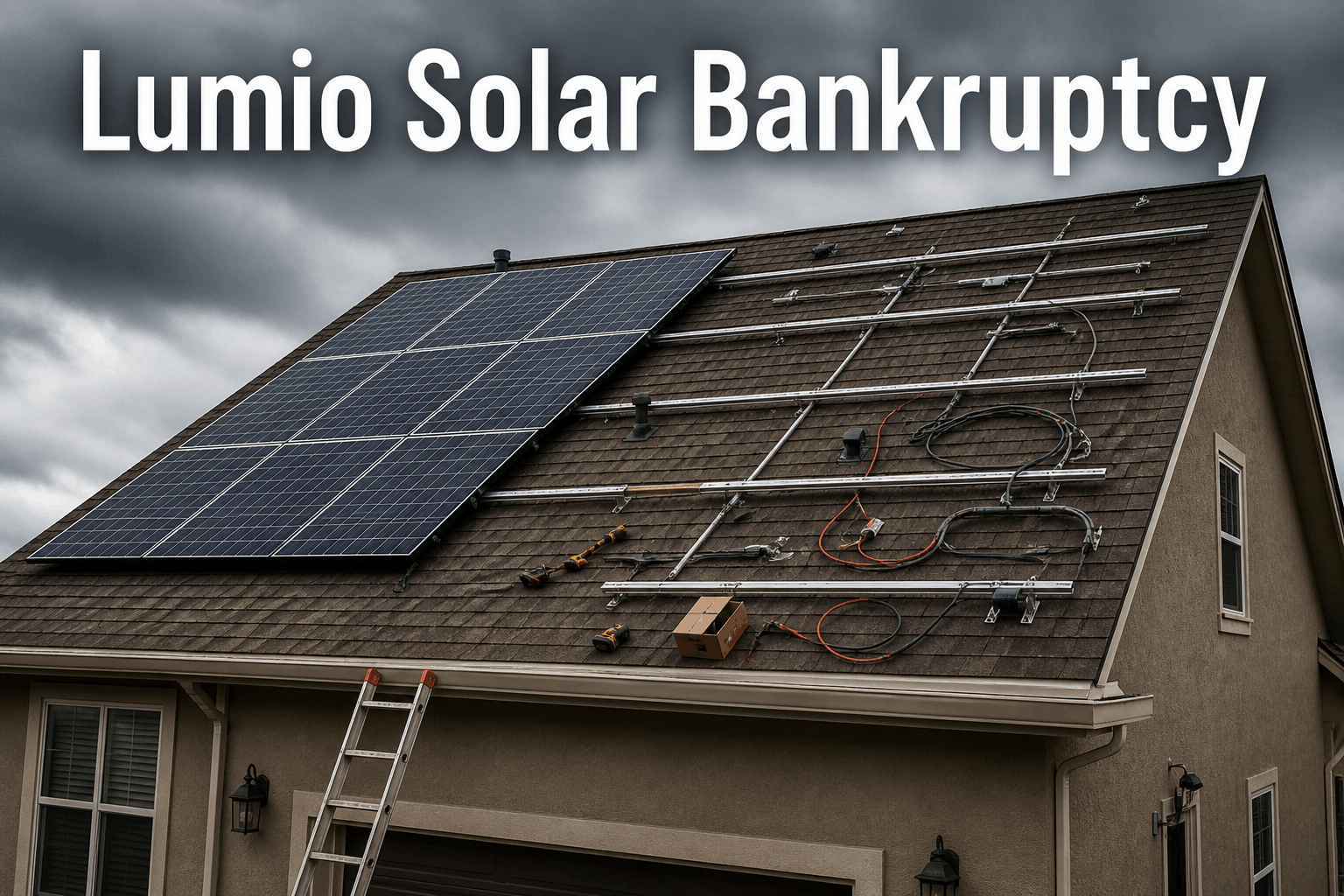
If you were a Lumio solar customer, you already know the frustration. Your installer went bankrupt not once, but effectively twice and now you’re left holding a system on your roof, a loan you’re still paying, and a warranty that may be worthless. That’s hard enough. But here’s what most homeowners don’t realize: the tax side of this mess can hurt just as much as the installation side, and it’s the piece almost nobody is talking about.
This guide breaks down exactly where the Lumio bankruptcy stands as of 2026, what it means for your federal Investment Tax Credit (ITC), and what steps you can take right now to protect money that is legally yours.
What Actually Happened with Lumio The Full Timeline
Lumio Holdings, Inc. launched as a national residential solar installer formed by merging five regional companies. At its peak, the company claimed over 3,500 employees and operated in 37 states, pitching itself as a one-stop shop for homeowners looking to go solar.
The collapse happened fast. Here is the condensed timeline that every Lumio customer should understand:
- September 3, 2024 — Chapter 11 Filing. Lumio filed voluntary Chapter 11 bankruptcy in the U.S. Bankruptcy Court for the District of Delaware. At the time of filing, the company had already narrowed from 37 states to just 16. The company announced a stalking horse asset purchase agreement with White Oak Global Advisors — a $100 million credit bid — and projected the sale would close within two months.
- November 1, 2024 — Sale to Zeo Energy Closes. Instead of White Oak’s original bid, the bankruptcy court approved the sale of substantially all Lumio assets to Zeo Energy Corp. for $4 million in cash plus 6.2 million shares of Zeo stock. That is a sharp fall from the $100 million figure floated just weeks earlier — and it tells you a lot about how little was left to sell.
- February 18, 2025 — Liquidating Plan Takes Effect. The case transitioned from a reorganization attempt to a liquidating plan. Lumio as a corporate entity is effectively gone. This is not a company that is restructuring and coming back. It is winding down.
- Ongoing in 2026 — Customers Left Without Support. Thousands of homeowners across 16 states are still discovering that Zeo only took on Lumio projects that had not yet reached Permission to Operate (PTO) status before November 1, 2024. If your system was already active by that date, Zeo did not acquire your contract. You are on your own.
The broader picture makes this even more alarming: Lumio is not an isolated failure. This bankruptcy is part of a two-year wave that has swept through the residential solar industry, including SunPower, Sunnova, Mosaic, PosiGen, Titan Solar, and most recently Freedom Forever, which filed Chapter 11 in April 2026. What happened to your installer is not bad luck — it is a systemic problem, and understanding that helps you know what to do next.
Your ITC Is at Risk — Here Is Why That Matters
The federal Investment Tax Credit also called the solar ITC is one of the most significant financial benefits attached to a residential solar purchase. Under Section 25D of the Internal Revenue Code, homeowners who bought and owned their systems outright could claim a 30% tax credit against their federal income tax liability.
To give you a sense of scale: on a $25,000 system, that is $7,500 coming directly off your federal tax bill — not a deduction, a dollar-for-dollar credit.
Here is the critical news for 2026: the residential ITC under Section 25D officially expired on December 31, 2025. The One Big Beautiful Bill, signed into law on July 4, 2025, ended this credit for homeowners who own their systems outright. There is no phase-down it ended completely for new purchases after that date. If you installed your system while Lumio was still operating and you haven’t yet claimed your ITC, this deadline makes your situation even more urgent.
What Can Go Wrong With Your ITC After a Bankruptcy
The IRS does not automatically know that your installer went bankrupt. They only see what you report. But a bankruptcy creates several real risks to your credit claim:
- Missing or inaccessible documentation. The ITC requires a clear paper trail of what you paid, when you paid it, and what was installed. If Lumio handled your billing and your customer portal is now offline, gathering those records becomes your problem.
- Incomplete installation. If your system was sold by Lumio but never reached PTO status before the bankruptcy sale, and Zeo did not pick up your contract, you may have paid for a system that has never legally produced electricity — which creates complications for when the credit can be claimed.
- Incorrect cost basis. Some homeowners discover after a bankruptcy that the contract price included items that don’t qualify for the ITC, or that rebates received reduce the eligible cost. Without access to your original itemized contract, calculating the correct credit amount becomes difficult.
- Claiming the credit in the wrong tax year. The ITC is claimed in the tax year the system is “placed in service” — meaning installed and operational. If your Lumio system had a complex installation timeline spanning multiple years, getting this right matters.
None of these issues automatically disqualify your credit. But they do require someone who understands both solar tax law and bankruptcy law to sort through.
Your Warranty Is Gone — But You Still Have Legal Options
Let’s be direct: Lumio’s workmanship warranty is void. When a company liquidates, the warranties it issued die with it. The entity that was legally obligated to honor your 10-year installation warranty no longer exists.
Your equipment warranties from the solar panel and inverter manufacturers remain intact. Those are issued by the manufacturers directly and survive the installer’s bankruptcy. If your panels are defective, you can still file a claim with companies like SunPower Panels, LG, or whoever manufactured your specific equipment.
But here is where homeowners consistently leave money on the table: the FTC Holder Rule.
The FTC Holder Rule — A Federal Lifeline
If you financed your Lumio solar system through a third-party loan, federal law gives you significant protection. The FTC Holder Rule (16 CFR Part 433) states that any company holding your loan is subject to the same legal claims you could have asserted against the seller.
In plain language: if Lumio breached your contract — by failing to deliver a functioning system, failing to honor a warranty, or misrepresenting what you were buying — you may be able to assert those claims directly against your lender. That could mean having your loan balance reduced or even canceled, and potentially getting back payments you have already made.
This is not a loophole. It is a federal consumer protection law specifically designed for situations where the seller disappears. But it requires properly notifying your lender in writing and often requires legal help to execute effectively.
Step-by-Step: What Lumio Customers Should Do Right Now
Here is a practical action plan. Start at the top and work your way through.
Step 1: Pull Every Document You Have
Before you do anything else, gather every piece of documentation related to your Lumio system. This includes your original contract, loan documents, installation agreements, any warranties or service agreements, all invoices and payment records, and any email correspondence with Lumio representatives.
If your contract was signed electronically and you can no longer access the Lumio customer portal, check your email inbox — you likely received PDF copies at the time of signing. Check both your regular inbox and spam folders.
Step 2: Determine Your System’s Current Status
You need to know exactly where your system stands:
- Is it physically installed and operational?
- Has it received Permission to Operate (PTO) from your local utility?
- What year was it placed in service the year it became operational?
- Was your contract transferred to Zeo Energy, or were you excluded from the acquisition?
Contact your utility company directly if you’re unsure about PTO status. They maintain records independent of your installer.
Step 3: Locate Your ITC Records and Confirm Whether You’ve Claimed It
If your system was installed and became operational before the end of 2025, you likely qualify for the residential ITC — but you need to confirm whether you already claimed it on a previous tax return, and if not, whether you can still file or amend a return.
The ITC is claimed on IRS Form 5695 and filed with your Form 1040 for the tax year the system was placed in service. If your system became operational in 2023, for example, the credit should have been claimed on your 2023 tax return. If it wasn’t, you may still be able to file an amended return — but there are time limits. A solar tax specialist can confirm your exact position. Firms like Solar Tax Pros focus specifically on this kind of solar tax situation and can help you determine whether you still have a valid claim and how to document it properly.
Step 4: Notify Your Lender in Writing
If you financed your system and Lumio failed to deliver what was promised whether that is a fully operational system, a valid warranty, or completed installation — send a formal written notice to your loan servicer.
In that letter, state clearly that your installer has filed for bankruptcy, identify the specific ways the contract was breached, and notify the lender that you are asserting your rights under the FTC Holder Rule. Keep a copy and send it via certified mail or with a delivery confirmation.
Step 5: Consult With a Solar Tax and Legal Professional
This is where it gets nuanced enough that you shouldn’t go it alone. The intersection of solar tax credits, bankruptcy law, and consumer protection statutes is genuinely complex. A mistake in how you claim or document the ITC could mean losing the credit entirely, even if you are legally entitled to it.
Look for professionals who work specifically in solar tax law — not general tax preparers who have seen a few solar returns. Specialists like Solar Tax Pros understand the interaction between the ITC, your installer’s bankruptcy, your loan structure, and the specific IRS documentation requirements that apply to your situation. That expertise is worth a lot when you’re talking about a $7,000+ credit on the line.
The Bigger Picture: Why Solar Installer Bankruptcies Keep Happening
Understanding why Lumio failed helps you make smarter decisions going forward — whether you are trying to recover from this situation or evaluating a new solar purchase.
The residential solar industry ran on a combination of aggressive sales, thin margins, and cheap financing. When interest rates rose sharply and California changed its net metering rules in 2023 (dramatically cutting what utilities pay homeowners for exported solar energy), the economics collapsed for installers who had built their business on high-volume, low-margin sales.
Lumio was not uniquely mismanaged — it was a victim of the same structural problems that took down SunPower, Sunnova, Titan Solar, and most recently Freedom Forever. These were not small operations. Freedom Forever was the second-largest residential solar installer in the country as recently as 2025, and it filed Chapter 11 just six months later.
The lesson for homeowners: the size and brand recognition of an installer does not protect you. What protects you is owning your system outright (or understanding exactly what a lease or PPA means for your ITC eligibility), having proper documentation from day one, and working with advisors who understand the tax implications of your specific financing structure.
What About State Incentives and Net Metering?
The federal ITC gets most of the attention, but state-level programs can add significant value — or, in some states, create additional complications when an installer goes under.
Many states offer their own solar tax credits, rebates, or Solar Renewable Energy Certificates (SRECs). These state programs are generally separate from your installer’s solvency. Your state’s rebate was paid when your system was installed, not ongoing. SRECs are tied to your system’s production, not your installer.
Net metering — the arrangement that lets you sell excess solar power back to the grid — is a utility program, not an installer program. Your Lumio bankruptcy does not affect your net metering agreement directly, as long as your system is operational and your utility has you enrolled.
The complication arises if your system is not yet operational. If Lumio never finished your installation and Zeo didn’t pick up your contract, you may be enrolled in a net metering program for a system that doesn’t actually produce electricity. Sorting out that situation requires both a technical assessment of your system and, potentially, legal action to address who is responsible for completing the work.
Choosing the Right Advisor After a Solar Bankruptcy
Not all tax professionals understand solar. Not all solar professionals understand tax. The Lumio situation sits squarely at the intersection of both, and the wrong advisor can cost you more than they save.
When evaluating someone to help with your ITC claim or Lumio-related issues, look for these things:
- Experience specifically with the federal solar ITC, not just general energy credits
- Familiarity with IRS Form 5695 and the documentation requirements under Section 25D
- Understanding of how bankruptcy affects tax credit eligibility and cost basis
- Knowledge of the FTC Holder Rule and how it applies to solar loan disputes
- Willingness to review your specific documents before giving you advice
Firms that focus exclusively on solar tax situations — like Solar Tax Pros — bring the kind of specialized experience that general tax preparers simply don’t have. When the credit at stake could exceed $8,000 or more, working with someone who does this every day makes a meaningful difference.
Don’t Let the Bankruptcy Cost You Twice
If you were a Lumio customer, you’ve already been let down once. The company that sold you a long-term energy solution couldn’t make it past four years. That stings financially and personally.
But the ITC is federal money that belongs to you if your system qualifies. The FTC Holder Rule is federal law that protects you if your lender is sitting on a loan for a broken promise. These are not hypothetical rights they are real, enforceable, and time-sensitive.
The homeowners who come out of the Lumio bankruptcy in the best position are the ones who act now: they gather their documents, they understand their system’s status, they file or amend their tax returns correctly, and they get proper legal and tax guidance before the window closes.
Don’t let the bankruptcy cost you twice — once on the warranty you lost, and again on the tax credit you failed to claim.